

01-04-2026 - A NEW START, A NEW HEART - Chronicles 14
- Lou Hernández

- Jan 7
- 14 min read
Updated: Jan 11
MESSAGE BY PASTOR ROB INRIG
FROM BETHANY BAPTIST IN RICHMOND, BC

+++++
I invite you to pray together: O Father of mercies and God of all comfort, our only help in time of need: We humbly beseech thee to behold, visit, and relieve thy sick servants for whom our prayers are desired. Look upon them with the eyes of thy mercy ( Vicky O, Nancy R, Tere G, Liz N, Stevie A, Socrates D, Sara's mom H, Margarita G, Rosy Ch, Patricia L. Lina J. Magda- Laci M. Gloria F, Miguel A H. Silvia H, Manuel D, Brianda M, Alejandro M, Natalia M, Oscar ND. Comfort them with a sense of thy goodness; preserve them from the temptations of the enemy; and give them patience under his affliction. In thy good time, restore them to health, and enable them to lead the residue of their life in thy fear, and to thy glory; and grant that finally they may dwell with thee in life everlasting; through Jesus Christ our Lord. Amen.
You can add names from family and friends who need prayer
+++++
As we take first steps into the year ahead, I want to focus on a time of new beginnings we read of in Scripture. In this Scripture, we are introduced to a revival God has brought. The background is Israel after some unsettling years. Under King David they have known great glory, but not long after they are in decline. Solomon begins well and ends badly. Then his son Rehoboam, much of his reign foolish, leading to the nation breaking in two: a rebellious, frequently evil Israel in the north and a wayward Judah in the south. In our passage this morning we see Asa becoming king of Judah after Rehobam’s son, Abijah dies.
Let’s read: Abijah slept with his fathers, and they buried him in the city of David. And Asa his son reigned in his place. In his days the land had rest for 10 years. And Asa did what was good and right in the eyes of the Lord :1,2
Let’s stop here for an observation. Most commentators believe Asa became king when he was 18-20 years. Imagine at that age taking on the immense challenge of serving as Judah’s king. Yet it’s important to capture that God uses who He wants, when He wants, how He wants. This to say, you don’t have to have a seminary degree or years of preparatory experience before God can powerfully use you. You don’t have to be a certain age, have the supposedly right personality or right charismatic gift. It doesn’t require that you be in a certain job. Yes, in this case a king but think of the others we see throughout Scripture - the royal and the ruined, those thought worthy and those thought despicable, those who look after sheep and those who plant crops, tax collectors and fish collectors. In all these, God unconcerned about pedigree but looking on the heart- a heart that is right oriented to God. That heart not a matter of age but of focus. Who do I serve, Who do I follow?
What’s interesting about Asa is that we are told, the Lord was his God. That may seem like an obvious but it’s not. He certainly never saw this in his dad who was a double minded king who worshipped idols and YHWH at the same time. Nor was it was evident in his grandfather, Rehobam who as time went by, erected one idol after another in the land. It was he who minimized God while maximizing a host of other options that could be worshipped. And the one revered, acclaimed as so wise, great grandpa Solomon was no better. It was he who first set his son in the wrong direction. He rejecting God’s command by marrying foreign wives, most of whom introduced their gods into their family and from there into the nation. But in these words, the Lord his God, Asa clearly declared who would rule his life. He boldly standing apart from what his family represented and he, standing apart from what surrounding culture first came to tolerate, then accept, then believe, then wholeheartedly adopt.
He - living in a culture just like ours, they - those in this culture no different than the proverbial frogs in the pot, blissfully swimming in the waters that were killing them.
But Asa, choosing at this time in his life, to be different, he understanding that in waters like these you must choose - understanding that one view is not equal with another. It’s exactly what some of you had to do - choose, your decision to follow Jesus despite what family and friends believed. It’s actually what everyone must do - deciding for yourself who you will follow, who Jesus is. There is no family plan belief.
Deciding no different than what Israel had to do. Over 100 times in the OT God makes reference to “My people” - God choosing them but time and again Israel choosing not to live as His. As Deuteronomy tells us, The LORD did not set His affection on you and choose you because you were more numerous than other peoples, for you were the fewest of all peoples. But it was because the LORD loved you and kept the oath He swore to your forefathers that He brought you out with a mighty hand and redeemed you from the land of slavery, from the power of Pharaoh king of Egypt. Know therefore that the LORD your God is God; He is the faithful God, keeping His covenant of love to a thousand generations of those who love Him and keep His commands 7:7-9.
So given his background, how did Asa know and do what was good and right in the eyes of the Lord?
BY REVELATION AND BY RESOLUTION
The actions Asa will take are what God stated to Moses in Deuteronomy. Asa doing what was right in the eyes of the Lord is entirely different than just doing what is good. Doing good is admirable. It is the attractive that feeds the hungry, cares for the disadvantaged, seeks justice for the oppressed. Without doubt those things are what should characterize us as followers of Christ. But we are called to be far more than people simply known for being good. Being good is very often a descriptor of us rather than of Jesus who we are to serve. But doing what is right in the eyes of God is completely different yet it is what we as disciples are called to. People who do what is right in the eyes of God - God honouring, God elevating, God promoting, God acting - which is what we see in the following. Truly living right in the eyes of God is a matter of our heart, living not by obligation but living knowing we are loved and loving God in return.
Asa first deciding who God was to him and then acting consistent with the Lord being his God. He didn’t just talk his faith or pray his faith, he acted upon it. For clarity, as king over the nation God claimed as His own, Asa was acting in the full authority he’d been given.
He acted by destroying anything and everything that kept the people of God from living as the people of God that His word called them to be.
2. BY REMOVING WHAT WAS IN THE WAY
He took away the foreign altars and the high places and broke down the pillars and cut down the Asherim and commanded Judah to seek the Lord, the God of their fathers, and to keep the law and the commandment. He also took out of all the cities of Judah the high places and the incense altars. :3-5
Understand the picture, 1st by noting the descriptor we just read - foreign altars and high places. These altars are foreign altars. They don’t belong here. They belong to a different place and a different people. They have been set up in a land that is not theirs. Which is what we need to understand. These altars don’t belong with the people of God, altars that seek to capture our attention and attract our love. Notice, they are erected up high where they stand in unavoidable view. They draw us close by the incense that lures. Given these attractions, they tempt with deceit, why not just come close enough to see what others are enjoying? Because that is how foreign altars and high places work. Presenting something new, something not seen before, something missed out on, something we dare not miss.
What these places actually offer but don’t immediately reveal are the idols and pagan deities introduced, in Israel’s case, gods like Baal, Isis, Molech and a multitude of others. Many of these gods coming from the Canaanite culture appealing to human desires associated with fornication, drunkenness and sacred prostitution. These high places on elevated platforms or high ground, their shrines presenting objects of worship with activities including animal sacrifices 1 Kngs 3:2, prostitution Jer 3:2, the burning of incense 1 Kngs 3:3, and human sacrifice 2 Kngs 23:20. The groves or asherah were typically a wooden image or pillar representing Ashtoreth a Canaanite goddess.
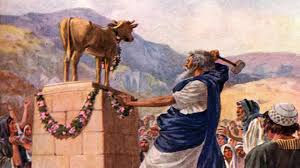
Amos charged Israel that these rites profaned the name of God Amos 2:7 and God warns Moses about Canaanite influence instructing the Israelites to destroy all the inhabitants of the land so that they would not be tempted to follow their gods. They were also instructed to destroy the high places, the wooden asherim, pillars, and graven images associated with the sexual aspects of their worship Deut 7:1-5, 12:2,3, 20:18.
Obviously those high places are different than what surrounds us. And in our case the incense - many times good, nothing of concern like our interest in sports, hobbies, entertainment or vocation but if those attractions disproportionally consume our time as they win our hearts and shape our beliefs, no different if they keep us from truly knowing God.
The real question is for us to understand that in the world in which we live, we need to decisively determine for Whom we live and with that, to evaluate how we live not in the high places we tear down around us but in the high places we tear down within us. Where we have other loves more important than Jesus, other priorities pursued more than Him, more time invested than the Sunday check ins we give Him.
Put simply, we have a love problem where God is calling us back - to once again reclaim and reignite our first love of Him, where we once again see Jesus for who He is without the clutter, without the distractions. I know this is what God is placing on Joanne’s and my heart for this coming year. To seek Him not so much to seek what He will do but seek Him - to spend time with Him in prayer and in His word. And that requires getting rid of the things that get in the way. Could it be that above all else, this is also what God is calling you to as well? Not to remove things for the sake of removing them but for the sake of knowing Him, of loving Him.
That primarily our actions aren’t to be focused on what needs to be removed from the world around but from the world within. When we allow God to do that, how we speak to the world around will be radically different. It will be marked by grace not anger. It will be witnessed in attitudes that love not condemn. It will bear evidence not of us but of the One we love as the Holy Spirit works in us and through us, The fruit of the Spirit is love, joy, peace, forbearance, kindness, goodness, faithfulness, gentleness and self-control Gal 5:22-23.
It was that action of removal that Asa saw as a priority one as he went through Israel totally removing whatever it was that was keeping him and anyone else from doing what God had called them to do. His actions bold. His actions decisive. His actions immediate.
3. BY RESTORING WHAT HAS BROKEN DOWN
But Asa didn’t stop at removal his next act was to restore. To go back and repair what had broken down and to build in places where no walls had been. The truth is nature will fill a vacuum and that is no more true than what happens in the spiritual. If we empty the things that are wrong and don’t fill it with things that are right, the wrong will soon come rushing in.
He built fortified cities in Judah, for the land had rest. He had no war in those years, for the Lord gave him peace. And he said to Judah, “Let us build these cities and surround them with walls and towers, gates and bars. The land is still ours, because we have sought
the Lord our God. We have sought Him, and He has given us peace on every side.” So they built and prospered. And Asa had an army of 300,000 from Judah, armed with large shields and spears, and 280,000 men from Benjamin that carried shields and drew bows. All these were mighty men of valor. :6-8.
Asa understood that despite their present reality of peace, time would come when enemies would rise up against them. That meant building walls of protection, of shoring up what had become weak. Recently we needed to do some home renovations. We stepped into this because incredibly it seemed that every time we turned around, something major was falling apart. In the process we were told that the roof hadn’t been supported as it should have been nor the floors fortified as they’d needed to be. That meant new support beams to carry the load.
In the same way Asa saw what needed to be done to prepare for what may lay ahead. That meant the building of surrounding walls. It meant the installation of doors to guard against enemy access and the provision of bars to fortify the gates. There would be towers which would rise high above the walls allowing enemies to be seen long before they came. In line with this, there was the formation of a skilled and prepared army chosen for their valour and their skill in battle.

During peace time, it’s easy to consider expenditures like these as unnecessary. Surely money and manpower could be used in better ways but the truth is, battles will come which calls us to do the preparatory work now. In our case, to return to the Word of God and be grounded in God’s truth. To speak His truth into our anxieties and fears. Make no mistake our fears will speak loudly and repeatedly to us which is why His truth reassures, Cast all our cares upon Him for He cares for you. Do not fear, for I am with you. Peace I leave with you; my peace I give you 1 Peter 5:7, Is 41:10, Jn 14:27 To declare His truth upon our decisions and actions, Your Word is a lamp unto my feet, and a light unto my path. It shows me the way I should go, both night and day. The Lord directs the steps of the godly. He delights in every detail of their lives. Though they stumble, they will never fall, for the Lord holds them by the hand Ps 119:105, 37:23. In the face of difficulty, the Lord’s hand bringing victory:
4. BY REVIVAL
Like what those living in Israel experienced in Oct 7, 23 but also in of October of 1973 while people fasted for Yom Kippur, a coalition of nations led by Egypt and Syria made a surprise invasion. The conflict, later known as the Yom Kippur War, began on October 6 and ended 19 days later, Israel’s victory miraculous, since the off guard nation was massively outnumbered.
At the time, 21 year old Lieutenant Zvika Greengold was home on leave, October 6 when he heard the sound of Israeli fighter jets roaring through the sky. Knowing no military exercises would ever take place on a high holy day, he rushed to his radio to find out what was going on -to find that his nation was under attack. Greengold immediately hitched a ride to a nearby command center, only to find that all the tanks had been deployed. However, he located two damaged tanks sitting at a repair depot. After hastily assembling a crew from back-up staff left on the base, he radioed the brigade commander that he had a ‘tank force’ ready to go. He was cleared for battle and received the code name Koah Zvika (Zvika’s Force).
IDF troops (Fuerzas armadas de Israel) in the area heard the radio report that ‘Zvika’s Force’ was joining the action. Thinking reinforcements were coming to their rescue, they were encouraged having no idea that rescue force was comprised of only 2 damaged tanks.
Greengold’s men immediately engaged advancing Syrian tanks, destroying 6 but his vehicle was damaged so he switched to the other tank and sent the damaged one back for repairs. Taking advantage of darkness and moving constantly from one spot to another to find good firing positions, he managed to fool the Syrians into thinking the opposition was a significant threat.
Joined by a few other tanks, Greengold displayed an astounding knack for repeatedly showing up at precisely the right moment to shift the momentum in favor of the Israelis. In one such encounter, enemy fire hit the tank he was in. The tank driver was killed and Greengold’s uniform was aflame. Though he was severely burned and wounded by shrapnel as well, he jumped out of the burning tank and hopped into the only other operational tank with him at that point. Then the one-man Zvika Force continued driving to various strategic positions in the area, firing on the approaching Syrian tanks with deadly precision.
In what came to be known as The Battle of the Valley of Tears, the Zvika Force and a handful of other tanks held off the advance of 100’s of Syrian armored vehicles. After 3 days of battle, the forces defending the Golan Heights had just 7 tanks left out of the original 100. There were no reserves behind them, only an open road to the center of the country. Miraculously, on the 4th day of battle, the Syrians retreated, just as the Israeli defences were about to collapse.
In Exodus 6:7 God told His people that He would be their God and they would be His people. It was His covenant, and all they had to do was follow. Follow even when it may appear all is lost, when what we face seems insurmountable. Like what we read next:
Zerah the Ethiopian came out against them with an army of a million men and 300 chariots, and came as far as Mareshah. And Asa went out to meet him, and they drew up their lines of battle in the Valley of Zephathah at Mareshah.
Without question, on the human Asa had every reason to be concerned. Those coming at him far more numerous, far more powerful, far better fortified and equipped and yet ....

Asa cried to the Lord HIS God, “O Lord, there is none like You to help, between the mighty and the weak. Help us, O Lord our God, for we rely on You, and in Your name we have come against this multitude. O Lord, You are our God; let not man prevail against You.
In your name we have come. Notice this isn’t foxhole prayer, praying for help to One he did not know. This is personal prayer, relational prayer, trusting prayer, prayer of great need that is given over to God to do what he cannot do. Prayer to the One he believed and followed.
In your name we have come. Notice this isn’t foxhole prayer, praying for help to One he did not know. This is personal prayer, relational prayer, trusting prayer, prayer of great need that is given over to God to do what he cannot do. Prayer to the One he believed and followed.
So the Lord defeated the Ethiopians before Asa and before Judah, and the Ethiopians fled. Asa and the people who were with him pursued them as far as Gerar, and the Ethiopians fell until none remained alive, for they were broken before the Lord and His army :9-13.

Asa putting His trust in what the Lord promised him and us in what is told us in 2 Chronicles, If My people who are called by My name will humble themselves and pray and seek My face, and turn from their wicked ways, then I will hear from heaven and will forgive their sin and heal their land or what Zechariah tells us, Not by might nor by power, but by My Spirit,’ says the Lord of hosts or This is what the Lord says, He who made the earth, the Lord who formed it and established it - the Lord is His name: ‘Call to me and I will answer you and tell you great and unsearchable things you do not know.’ 2 Chron 7:14,15, Zech 4:6, Jer 33:2,3.

May that be our prayer as we come into this in the coming year. Our Saviour and Lord to Whom we come by: REVELATION AND RESOLUTION to return to our first love BY REMOVING WHAT WE’VE ALLOWED TO GET IN THE WAY BY RESTORING AND STRENGTHENING areas we’ve allowed to go weak and BY REVIVAL as we humble ourselves before God to do the powerful in and through our lives.


Comments