

05-31-2026 - WHEN ALL HOPE IS GONE - Acts 27:13-44 -
- Lou Hernández

- Jun 7
- 15 min read
All the messages are continue written by
Pastor Rob Inrig from Bethany Baptist Church
in Richmond, BC. Canada

This is the last message from a series of Acts,
As we are starting June, Pastor Inrig will start a new
series based on the book of Psalms.
+++++
I invite you to pray together: O Father of mercies and God of all comfort, our only help in time of need: We humbly beseech thee to behold, visit, and relieve thy sick servants for whom our prayers are desired. Look upon them with the eyes of thy mercy ( Vicky O, Nancy R, Tere G, Liz N, Stevie A, Socrates D, Sara's mom H, Margarita G, Rosy Ch, Patricia L. Lina J. Magda- Laci M. Gloria F, Miguel A H. Silvia H, Manuel D, Brianda M, Alejandro M, Natalia M, Oscar ND, Juan Carlos V. Comfort them with a sense of thy goodness; preserve them from the temptations of the enemy; and give them patience under his affliction. In thy good time, restore them to health, and enable them to lead the residue of their life in thy fear, and to thy glory; and grant that finally they may dwell with thee in life everlasting; And for those who have departed and are in eternal sleep, waiting for you to come, and with joy they will live eternal life with you.
Through Jesus Christ our Lord. Amen.
You can add names from family and friends who need prayer.
+++++
In many ways, the portion of Scripture we are looking at today will seem like a strange way to close off our look at the book of Acts. After all, it’s a rather long and detailed account of the shipwreck Paul experiences on his way to Rome, and it is how Acts ends.
If we leave it as a historical account, it can easily be glossed over as having small relevance to us, but in the story, I think it actually has some important things to teach. It’s true, few if any of us will ever experience the literal things we read of, but we will experience storms that sometimes come with the same gale-force winds that shipwreck us, leaving us gasping for breath. Our lives most often like the opening words of verse 13, When a gentle south wind began to blow, they saw their opportunity; so they weighed anchor and sailed along the shore of Crete:13 ....
At the start, things looked good. Gentle winds to get us out of the harbour and on our way. Winds needed to fill the sails and power us where we need to go. No reason for concern, but the gentle is not remaining gentle for very long - just gentle enough to get us out into deep water where the shelter and security of places we can run into are not close at hand. And when there’s no port in the storm to take shelter in, the hard becomes the catastrophic, its force threatening to take us under. So, to truly take what we can from this passage, we first need to enter into the swirling winds and waters of what we are about to read:
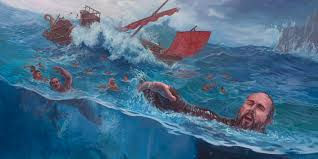
Before long, a wind of hurricane force, called the Northeaster, swept down from the island. The ship was caught by the storm and could not head into the wind; so we gave way to it and were driven along. As we passed to the lee of a small island called Cauda, we were hardly able to make the lifeboat secure, so the men hoisted it aboard. Then they passed ropes under the ship itself to hold it together. Because they were afraid they would run aground on the sandbars of Syrtis, they lowered the sea anchor and let the ship be driven along. :14-17.
Those who have studied seagoing vessels of the time describe this boat as likely having 1 sail and no rudder; instead, the steering was done by oars, which at the best of times would have the ship at the mercy of the sea. You are now on deck, moments before enjoying the journey, but now lashed to the rails so you’re not thrown overboard. Still, you - tossed around like a helpless rag doll. Those below deck are straining at the oars, but to what effect? In normal weather, the oars digging in are sufficient for the task, but in a hurricane, when waves rise to mountain heights and then crash to valley lows, oars of no use. You, terrified. Imagine the weather conditions and the precarious state of the boat that has your fellow seamen tying ropes around the ship to hold it together, everyone’s life dependent on the strength of that rope. Those ropes, your last attempt to maintain some semblance of control. Sure, other things later on will be done, but those are only fatalistic last efforts to survive.
Metaphorically, it’s not uncommon for you and me to do the same when we get hit with storms that turn our lives upside down. When those things first hit, we run into the things we have tied tightly around us to keep us safe: the accounts we have saved up, the health club memberships we’ve joined, the relationships we’ve cultivated, the trust currency we’ve earned. Yet those things, as strong as we thought them to be, as valuable as everyone told us they were, are insufficient to keep us safe when life’s storms are far stronger than anything we’ve faced. A relationship rips apart, an unexpected diagnosis is given, an economic tsunami strikes, and a trusted one betrays. Winds whipping away all the safeguards we thought indestructible. Our ability to stay on our feet, next to impossible.
Which takes us to the next part of what Paul experienced. We took such a violent battering from the storm that the next day they began to throw the cargo overboard. On the third day, they threw the ship’s tackle overboard with their own hands:18,19.
For these sailors, the cargo tossed was possibly things they would use a few weeks from now. Perhaps the things enjoyed during recreation times or the trunk that held the extra set of clothing used when going ashore. But when the immediate need is lightening the load to get us safely to shore, all those are cast overboard so they aren’t scraping bottom, opening themselves to a watery grave. The value of the toss is meaningless compared to what is at stake. No different for us that when life hits hard, treasured possessions begin to be seen for what they are - fabric and wood, coloured stone set in metal, a motor hidden in steel and plastic. Nice things, often important and/or valued in the everyday, but when life closes in, not essentials. Yes, sometimes those things are given immense value for what they provide, but when life hangs in the balance, not worth hanging onto. But the temptation to hang on to what we’ve trusted in is really strong.

It’s said James Dean, an actor of a past generation, died in a car crash largely due to his refusal to let go of his ‘fast, thrill and speed’ persona. Then there’s the wrestler, Usef, the Terrible Turk, a master of Greco-Roman wrestling. Standing 6'2" and weighing roughly 305 pounds, this undefeated wrestler was recognized as one of the three strongest men in the world, his brute strength often forcing opponents into submission.
On July 4, 1898, while returning home from victories in the US, his ship collided with another and sank. According to accounts, he died because he was reportedly wearing a belt containing the weight of his gold winnings. He is holding on to it, or it is holding on to him, taking him under. And the same is often true of us, as we hold on to things that in the end are unimportant.
The primary cargo in this case is what they jettisoned last - grain. This was their payload, the reason for the sailors’ journey and by which they could enjoy the fruit of their labour. It fed them when they went on shore leave and would feed the mouths at home. But now the reward it would bring is unimportant. Not with death staring them in the face.
Often it’s the storms that separate us from the things that drive our pursuits and occupy our hearts. That’s not to say that we shouldn’t value the things we have, the activities we enjoy, the relationships we treasure, but we need to be careful that those things aren’t elevated to the point where they become the things for which we live. The storms often reveal what’s important in our lives.
When neither sun nor stars appeared for many days, and the storm continued raging, we finally gave up all hope of being saved:20.
Though the words are few, they convey a powerful and depressing picture. Those on this ship now fully understand they are completely at the mercy of the sea. The storm un-abating. The visibility of where they are and where they are going, unknown. By all appearances, their situation is hopeless. Practically the only way they can navigate is by sighting landmarks known to them, and by what we read, those are covered over by day and not present at night. There is no sun giving light and no stars setting direction.

After they had gone a long time without food, Paul stood up before them and said: “Men, you should have taken my advice not to sail from Crete; then you would have spared yourselves this damage and loss. But now I urge you to keep up your courage, because not one of you will be lost; only the ship will be destroyed. Last night an angel of the God to whom I belong and whom I serve stood beside me and said, ‘Do not be afraid, Paul. You must stand trial before Caesar; and God has graciously given you the lives of all who sail with you.’ So keep up your courage, men, for I have faith in God that it will happen just as he told me. Nevertheless, we must run aground on some island’ :21-25.
No doubt all those on the ship are incredibly weary, physically depleted, sleep barely taken, desire for food forgotten - all added up to those without hope. And into the grim realities of what they are facing, Paul first words would hardly have been what they needed to hear but he couldn’t resist - Should have listened to me, told you so. I would think those words were the last thing they needed to hear but they did need to hear the words that followed - in the mess, he speaking hope, calling them to have courage - an island of rescue is ahead.

Hope is an amazing thing. In the 50s, Harvard psychologist Curt Richter conducted a controversial experiment where he placed rats in a container of water where they did their best to survive, but after 16 minutes of furious paddling, they succumbed, believing their situation was hopeless. Things were looking very much the same for a second set of rats who, at a similar 16-minute mark, gave up and began sinking; however, these rats experienced what the others hadn’t: they were rescued, lifted out, dried off and given a time of rest. But as they soon learned, their rescue was short-lived as they were returned to the water to begin their paddling all over again. Only this time their paddling didn’t last 16 minutes or even 16 hours. This time their paddling went on for 2½ days. 16 minutes on average, becoming 60 hours, they believed rescue would come. Holocaust survivor Viktor Frankl observed that prisoners who lost hope -the belief they had something left to live for - were those who died quickly.
The promise of hope enables us to carry on when everything around us tells us to give up. Solomon observed, Hope deferred makes the heart sick, but a dream fulfilled is a tree of life Prov 13:12. But for hope to mean anything, we need assurance that our hope is based on something that can be depended on rather than something just wished for. Because whether it’s 16 minutes or 2½ days, if the answer we are looking for is based on dreams, wishes or lies, what’s the point?
Given the storm they’ve been facing for days with no letup in sight, they certainly have every reason to agree with Solomon and feel heartbroken - hope barely on life support. And sea sick - stomachs long empty, no more left to give, these, until Paul spoke a promise to these no different than helplessly paddling rats, Not one of you will be lost; the ship will not make it, but you will. That’s a hard promise to hold onto when, no shore in sight, you are in the middle of the sea with no capacity to steer to shore even if it came into view. Keep in mind the sea Paul speaks of is 800 kms long and 100-160 kms wide. It’s into this he speaks his less-than-comforting words: The ship will be lost, but you won’t be.
Ever felt like that? The storm too big, the waves too strong - the pain too much, the pit too deep, the violation too big?
Yet even in the mess - something is happening. Something sensed. Something that perhaps was validating what Paul had said - giving hope. Nothing yet seen but something felt ....

On the fourteenth night, we were still being driven across the Adriatic Sea when, about midnight, the sailors sensed they were approaching land. They took soundings and found that the water was a hundred and twenty feet deep. A short time later, they took soundings again and found it was ninety feet deep. Fearing that we would be dashed against the rocks, they dropped four anchors from the stern and prayed for daylight.
Before this last portion we just read, Paul has said a few things that reassure, that bring some life support to hope. For a time, anxieties and fears are put on mute - but hope is hard to hang onto, fear wanting to reclaim the territory it has lost.
The truth is, life is filled with many things that can bring fear, when pain shouts loud, when wrong is done, when betrayal is given. Ugly, wanting to destroy times directed by our enemy, our enemy who specializes in disorder, fear and hurt. This same enemy who wants us to blame him for these, not on him who brings this, but on God whom he wants us to accuse. A God he wants us to see as one who may promise hope but who continually fails to deliver on what He promises, the echo always with us, Did God really say? Does God really do?
Unfulfilled dreams. Never answered promises. Instead, disappointment and fear. The enemy intends to have us see ourselves as prisoners of fear rather than believers in promise.
But when the Bible speaks of hope for the Christian, it speaks of something that can be known with certainty. Not necessarily certainty in the immediate or in certainty in ways we might ask, but certainty in what has been promised. It’s not certain that the cancer will be healed, the relationship will be restored, the finances will be renewed - though it’s possible these things might be things God will do. But in a world where we are told, the whole creation has been groaning together with labour pains until now. The creation is eagerly waiting with anticipation for God’s sons to be revealed Rom 8:22,19 the hope for the removal of all the ugliness now isn’t promised - not yet. What is promised is the assurance of something far greater - His faithfulness, His presence, His unwavering love. In these we have been given a new heart, new life, new identity, new power, new peace, new joy and so much more Ez 36:26, Jn 7:38, Ps 23:6, Mtt 11:28, Phil 4:7. All of these we are told are anchored in Jesus Christ, who is the "Yes" to all of God's great and precious promises.
This hope laid up for you in heaven, which you previously heard in the word of truth... seize the hope set before us. We have this hope as an anchor for the soul, firm and secure. An inheritance that can never perish, spoil or fade. This inheritance is kept in heaven for you Col 1:5, Heb 6:18,19, 1 Pet 1:4.
Yet the enemy does his best so we won’t hear this; his very best so we won’t believe this. So he ramps up the fear, wanting us to open the door to let fear come rushing back in. His voice whispers, Don’t believe in the promise; believe in what you see. Don’t believe in rescue; believe in the depth of the waters and the crushing strength of the rocks. Don’t believe in any promise of presence- that He’s with you in what you’re going through right now; believe in the truth of your pain, and with that as your guide, throw any God promises away. Act as your own saviour, in the truth you want to believe.
Which is exactly what the sailors tried to do next. In an attempt to escape from the ship, the sailors let the lifeboat down into the sea, pretending they were going to lower some anchors from the bow. Then Paul said to the centurion and the soldiers, “Unless these men stay with the ship, you cannot be saved.” So the soldiers cut the ropes that held the lifeboat and let it drift away: 27-32.
Fear revisiting, this time not because they are out too deep where no rescue could come, but now fearful because they are in waters too shallow, that will take them into the rocks.
This snippet is interesting. Those most at home on a boat want to get off, and those most at home on terra firma want to stay on. Sailors wanting to abandon ship and soldiers cutting ropes so the sea-wise can’t get off. It’s also interesting that these soldiers who hold Paul captive act under the instruction of their prisoner. They are acting not under the direction of those who know the sea but under the direction of the one who knows His God.

Paul made it clear that these soldiers needed to decide. Logic would say those familiar with the sea would know best what to do under the circumstances. The majority voice, the so-called informed voice, knows what evidence of the looming rocks conveys - undeniable indicators of the fate that awaits. The majority voice yelling, No hope, abandon ship. Yet a lone voice, God is our refuge and strength, a very present help in trouble. Therefore, we will not fear, though the earth be removed, and though the mountains be carried into the midst of the sea; though the waters roar and are troubled, though the mountains shake. There is a river; the streams shall make glad the city of God, the holy place of the tabernacles of the Most High. God is in the midst of her; she shall not be moved: God shall help her, and that right early. The heathen rage, the kingdoms were moved: He uttered his voice, the earth melted. The Lord of hosts is with us; the God of Jacob is our refuge. Ps 46:1-7
The voice of the many or the One Voice that needs to be heard. Who will we believe?
Years ago, I was sent to Vail for a week-long certification training in Strategic Planning. Most participants were upper-level executives from major companies. Leading the training was a man considered to be one of the best in the field. His rules, which we were to experience and then implement in our workplaces, were: #1 give participants more work than they could? O, do #2 keep room temperature cold and #3 allow no one to leave the room for any reason except at break times - meaning a can’t-be-missed call will be missed, important human functions will have to wait, and warnings of the catastrophic, like smoke or fire alarms, are to be ignored - we continue to work through. These upper level executives now compliant, all buying in, no one pushing back. Well wouldn’t you know it, on the 3rd day, sure enough, the smell of smoke began making an appearance in the room, followed by ringing fire alarms. And the amazing? No one moved. The majority like obedient sheep, their wills given over to another, holding fast to what they’d been told. Because he should know. This was his area of expertise. This sheep broke ranks, leaving the room - not followed for a time, until a few others made their move. And yes, this section of the hotel in which the training took place was on fire, with people scrambling to get out of their rooms. The loudest voice, the actions of the many or listening to One who knows us best?
The point - the hope we as Christians have is not a ‘popular opinion’ determination, nor is it some voice promising every wish fulfilled; our hope is ‘promise-keeping assurance’ from an unfailing God. This God who formed us and knows us by name. What that tells us is this: the hope He offers us will never disappoint; instead, it will far exceed anything we can imagine. That hope true in the fiercest of storms.
Just before dawn, Paul urged them all to eat. “For the last 14 days,” he said, “you have been in constant suspense and have gone without food—you haven’t eaten anything. Now I urge you to take some food. You need it to survive. Not one of you will lose a single hair from his head.” After he said this, he took some bread and gave thanks to God in front of them all. Then he broke it and began to eat. They were all encouraged and ate some food themselves. Altogether, there were 276 of us on board. When they had eaten as much as they wanted, they lightened the ship by throwing the grain into the sea. When daylight came, they did not recognize the land, but they saw a bay with a sandy beach, where they decided to run the ship aground if they could. Cutting loose the anchors, they left them in the sea and at the same time untied the ropes that held the rudders. Then they hoisted the foresail to the wind and made for the beach. But the ship struck a sandbar and ran aground. The bow stuck fast and would not move, and the stern was broken to pieces by the pounding of the surf. The soldiers planned to kill the prisoners to prevent any of them from swimming away and escaping. But the centurion wanted to spare Paul’s life and kept them from carrying out their plan. He ordered those who could swim to jump overboard first and get to land. The rest were to get there on planks or on other pieces of the ship. In this way, everyone reached land safely:33-44.
Hope?
God’s promise - for those whose trust is in Him.


Comments