

08-16-2026 - RETURN TO WORSHIP - PAYABLE ON DEATH -2 Chronicles 29:20-28

MESSAGE BY PASTOR DANIEL PARK
FROM BETHANY BAPTIST IN RICHMOND, BC.

The Power of Prayer
I invite you to pray and make this prayer personal. If you know someone who needs support during difficult times, please mention their names. Let us also pray for our family and friends. Here are some names to keep in mind: Vicky O, Nancy R, Tere G, Stevie A, Socrates D, Sara’s mom H, Margarita G, Rosy Ch, Patricia L, Lina J, Manuel D, Silvia H, Magda, Miguel H.L, Manuel D.H, Alicia G, Margarita G, Brianda M, Alejandro M, Natalia M, Maria Elena C, Oscar N.D, Luis Carlos V, and Alicia R.
I ask for your healing over every part of my life—physically, emotionally, mentally, and spiritually. I seek strength and resilience for the days ahead. I know you have a great purpose for those who believe in your name. Help me not to let the distractions and struggles of my days weigh me down to the point of exhaustion. Your desire is for me to live abundantly and freely. My greatest wish is to reflect your love and light to a world that desperately needs your hope.
For those I love who are facing cancer or difficult diagnoses, I pray for your covering of healing and grace. Fill their lives with strength and peace, reminding them that you are close. Thank you; nothing is impossible with you. Thank you for fighting for us. You are bigger than anything this world throws our way. I lean fully on You, Lord, for You alone are able. We love You and need You today and always.
In Jesus' Name,
Amen.
Special Prayer for Healing
Heavenly Father, God of all comfort and healing, we come to you with unwavering faith in this moment of profound need. We place in your loving hands the life of Ana Feri Sucar, who is in a coma after suffering a serious accident. You see her now, for you are the God who sees.
You are the God of miracles, the one who breathed life into creation and who is in control of each of our days. We ask that you send your healing power directly to her body. Restore every organ, heal every brain injury, align every bone, and cleanse every wound caused by the impact. Break her coma and awaken her according to your perfect will and mercy.
Lord, grant profound wisdom to the doctors, nurses, and all the healthcare staff caring for her. Guide their hands and decisions. Fill the hearts of her family with peace, strength, and hope; sustain them in this process and do not let their faith falter. We declare that nothing is impossible for you and that your love is greater than any medical prognosis.
In the mighty name of your Son Jesus, we pray and give thanks. Amen.
The Early Church and Its Misunderstandings
Did you know that early church Christians of the 1st century were accused of being cannibals? This was often used as propaganda by the Roman Empire during their persecution of Christians. The accusation stemmed from the practice of The Lord’s Supper—the communion—where Christians eat the “body of Christ” and drink His “blood.” From an outsider’s perspective, this misunderstanding is somewhat understandable.
Christians often talk about death. Jesus died for you because He loves you. It’s a calling card blessing! As strange or off-putting as it may sound, Christians have declared this truth unashamedly for 2000 years. It forms the foundation of our new life. We are new creations in Jesus Christ, but this new life was paid for by His blood.
The Gospel in a Song
There’s a worship song we don’t sing often anymore, but I believe it is one of the greatest. It has a simple melody and words that communicate a powerful and eternal truth. The song is "Lord I Lift Your Name on High" by Rick Founds, released in 1989.
The chorus goes:
You came from heaven to earth, to show the way
From the earth to the cross, my debt to pay
From the cross to the grave
From the grave to the sky
Lord, I lift your name on high
These five lines encapsulate the gospel message. The song embodies our worship. I live to lift Your name on high. I love to sing Your praises. I’m so glad You’re in my life. I’m so glad You came to save us.
Nature's Lessons: Fire and Renewal
There are many bushfires raging throughout Canada at the moment. Yet, we know that the forest ecosystem and many trees benefit from these fires to reproduce and thrive. New life often comes at a cost.
The Son of God, Jesus Christ, died so that anyone who believes in Him could have new life. Jesus died and paid the debt of sin, so that we won’t have to pay it with our death.

Worship: A Celebration of Life
Worship is the continual reenactment of the life, death, and resurrection of Jesus Christ. It is a celebration and reminder of His sacrifice. God created us to live in loving harmony with Him. However, our sin, which is rejecting and turning away from Him, is a matter of life and death—eternal life and death.
Sin takes us from eternal life to death. Only blood can make things right again. Blood is life, and only life can pay the debt of a sinner’s life.
[PAID IN BLOOD]
Hezekiah spent the first 16 days of becoming king ensuring that worshipping God was a priority again. He cleansed the temple for worship and consecrated the leaders for worship. He sacrificed many animals for burnt offerings and sin offerings.
Without going into too much detail, here’s a simple summary from the Bible Project of the different offerings in the Old Testament:
1 | 2 | 3 | 4 | 5 |
Grain Offering | Fellowship Offering | Burnt Offering | Purification Offering | Restitution Offering |
Two are ways of saying “Thank you” to God by giving back a part of what he’s given to you in produce and flocks | Three are different ways of saying “I’m sorry” to God for wrongs done to others or to God, resulting in forgiveness of sins. The three “I’m sorry” offerings are all said to “provide atonement” for the sin of the one who offers it, so that they are “forgiven” |
Of the five types, two—grain and fellowship offerings—are given to thank God for His providence. The other three—burnt, purification, and restitution/sin offerings—are given as part of repentance, to express “I’m sorry” to God for sins, so that people may be forgiven.

You can understand why Hezekiah emphasizes burnt and sin offerings. Led by Hezekiah’s father, King Ahaz, the entire nation had spent decades in sin and wickedness, worshipping idols and foreign gods.
The first and major aspect of worship is the restoration of our relationship with God. This requires cleansing, consecration, and repentance of sin. No one can have a relationship with God without repenting of our sins against Him.
The laws and ritual sacrifices laid out in the Old Testament show us what it takes to have a relationship with God. At the center of it all is the problem of sin.
Sin is explained in a few ways in the Bible. Literally, it means to “miss the mark.” It’s akin to shooting or veering off course. However, a better imagery might be to miss the point and fail. In the Old Testament, it is often connected with idolatry and disobeying God’s commands. In the Lord’s Prayer, Jesus prays, “forgive us our debts.” Some translations use the word “trespass,” but “debt” is the better translation of the original Greek word, which has a financial nuance.
So, sin is like a debt incurred to God that must be satisfied—paid off. But sin is not merely a matter of numbers or wealth; it is a matter of life. It requires life in payment. This is why God taught the Israelites the rituals of offerings and animal sacrifices, where the animals took the place of people.
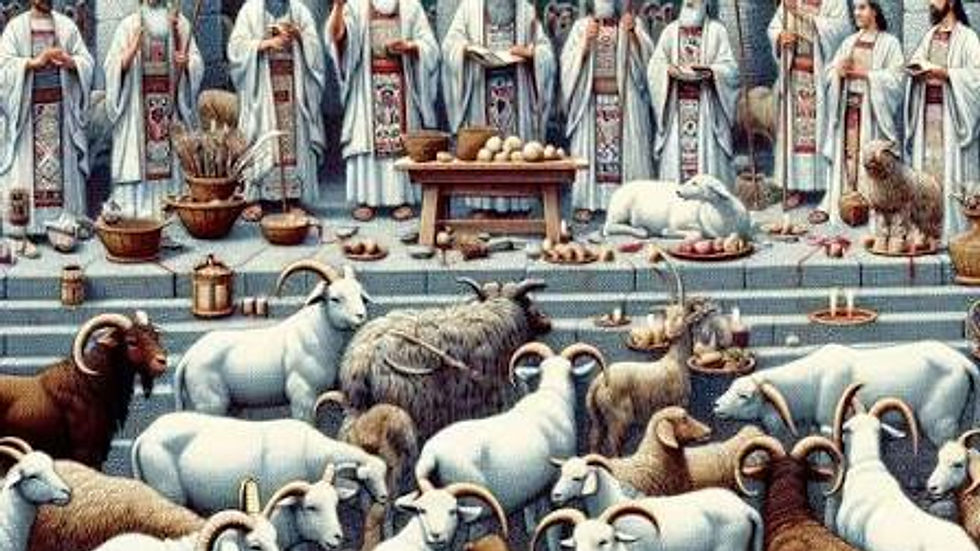
This was far from perfect and permanent, so they had to do this continually because everyone sinned continually.
Can you imagine? Every Sunday, Rob having to slaughter a bunch of different animals? Aren’t you glad we don’t have to do that anymore? But why not? What has changed? We still sin.
Because Jesus paid it all!
Hebrews 9 (NLT) states:
11 So Christ has now become the High Priest over all the good things that have come. He has entered that greater, more perfect Tabernacle in heaven, which was not made by human hands and is not part of this created world.
12 With his own blood—not the blood of goats and calves—he entered the Most Holy Place once for all time and secured our redemption forever.
13 Under the old system, the blood of goats and bulls and the ashes of a heifer could cleanse people’s bodies from ceremonial impurity.
14 Just think how much more the blood of Christ will purify our consciences from sinful deeds so that we can worship the living God. For by the power of the eternal Spirit, Christ offered himself to God as a perfect sacrifice for our sins.
Jesus is the new and life-giving way to repentance and forgiveness. It’s a life-giving way because it does not require continual deaths—just one death, and that was Jesus on the cross, which has already been done. It’s new and life-giving because after Jesus died to pay for our sins, He was raised back to life. That resurrected life is promised to all who believe in Jesus.
Our worship is the recognition of Jesus Christ, God’s own Son, who was offered up as a sacrifice in the place of all. His blood is able to purify us once and for all. This is why worship is the continual reenactment of the life, death, and resurrection of Jesus Christ. Without Jesus, our worship is incomplete and unfulfilled. Our sins are still payable by death, but thank God it has been paid by the death of Jesus Christ. That is the basis of our worship.
[Sacrifice of Praise]
At the same time as the offerings were being made, Hezekiah had the Levites—who were like the worship, tech, ushering, and hospitality ministry of their time—leading everyone in worship with music, using various instruments and voices.

Throughout the Bible, music goes hand in hand with worship, as we see in today’s passage. Music is a special language that combines body and soul. It’s a natural element for worship.
Charles Spurgeon humorously said, “Should the worshipers of wine sing so enthusiastically, and we be silent? We are not often guilty of disturbing the world with our music.” If worship is our obsessive expression of prioritizing God, then the music that accompanies this obsession should reflect similar passion, energy, and volume.
In today’s passage and elsewhere in the Old Testament, music often accompanied true worship at the temple and altar of sacrifices. This arrangement was “according to the commandment of David and of Gad the king's seer and of Nathan the prophet, for the commandment was from the Lord through his prophets.” (V.25) Worship music and music in worship are integral to the proper worship of God. The trumpets and other instruments sounded, and the singers sang as the whole assembly worshipped.
Music expresses and amplifies our worship—our offerings to God, the sacrifices connected to our thanksgiving and repentance.
I mentioned before that worship is the continual reenactment of the life, death, and resurrection of Jesus Christ. We remember and revere what Jesus did to save us because He loves us. This includes how He served those He loves, culminating in the ultimate sacrifice—dying for us. Our worship must be characterized by sacrifice. As King David exemplified, “I will not offer burnt offerings to the Lord my God that cost me nothing.”

Everyone here sacrificed something to be present right now—time, money, and other opportunity costs. But is it a sacrifice of praise and joy? A sacrifice that honors God? One that acknowledges and responds to Christ’s salvation? Or is it a sacrifice of convenience, expectations, duty, or choice?
To quote Spurgeon again, “The most acceptable gift given to God is the gift that is given joyfully.” We can be joyful in sacrifice when we know it’s worthwhile. Jesus is absolutely worthy of all of it!
Last week, I mentioned that Sunday worship service is the beginning of our worship—the least of our worship. Today, I want to add that the sacrifices of our Sunday worship—the time, cost, offerings, tithes, and volunteering—is the least of our sacrifice. Not that it is worth-less, but that it is the starting point of our sacrifice—a lifestyle.
Worshipping in spirit and truth is being obsessed with Jesus, who makes it possible for us to have a relationship with God. Worship is how we connect with an invisible God. We worship Jesus, who became the final sacrifice for every sin of every sinner. Worship is new-life-giving.
This is why worship is the most important thing we do in life.


Comments